

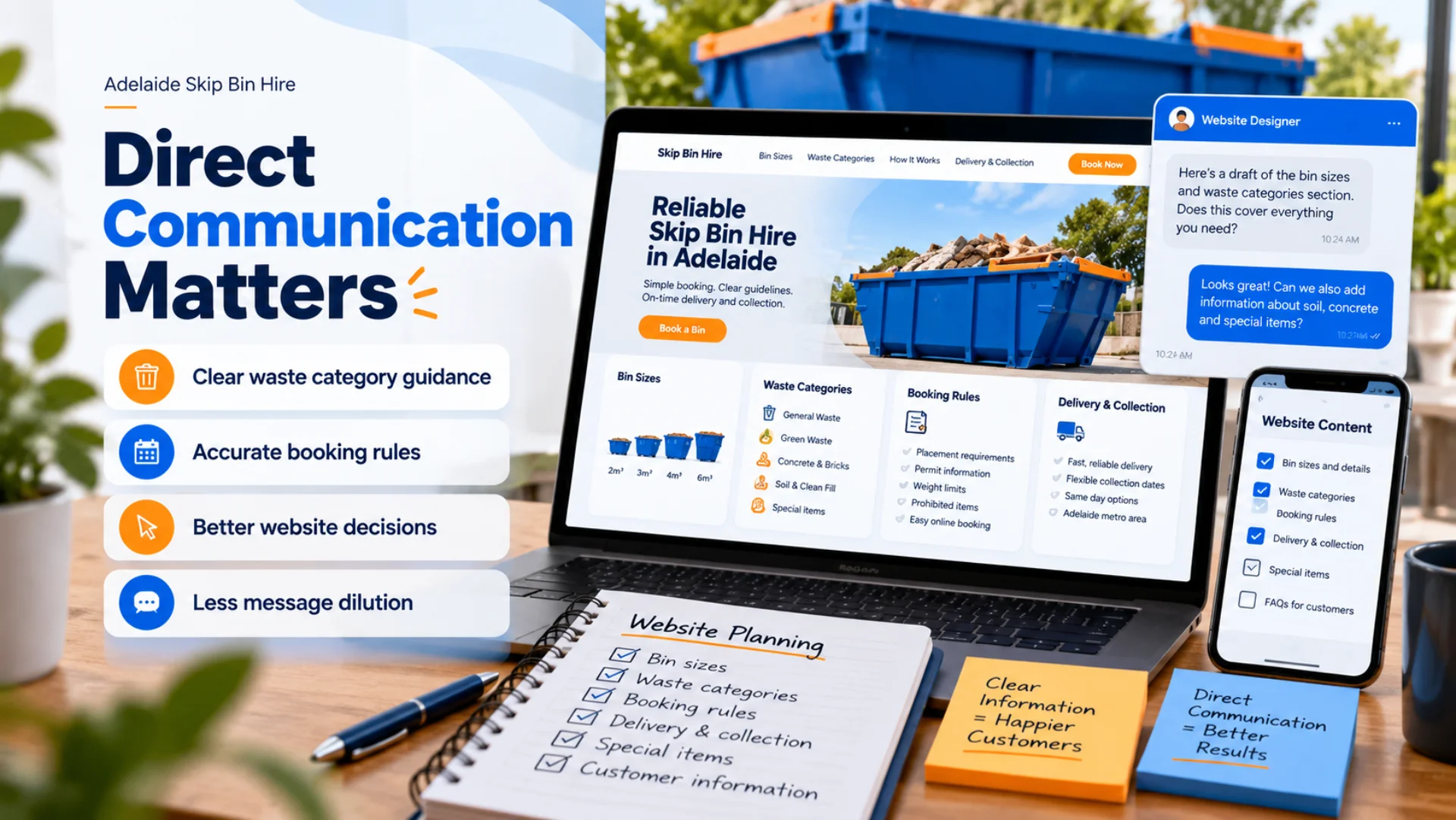
Why I Wanted to Speak Directly to the Person Building Our Website
Direct communication with a website designer was important to me because our website had to reflect how our business actually works. For a skip bin business, small details about waste types, booking conditions and customer instructions cannot afford to get diluted between sales, account management and development.
At Adelaide Skip Bin Hire PTY LTD, our website has to communicate practical information accurately.
We serve households, businesses, builders and tradies across our listed Adelaide service area. Customers may need to choose between different waste categories, select an appropriate bin size, understand what their hire includes and check what can or cannot go into a particular bin.
That was one reason I placed so much value on being able to discuss our website directly with the person responsible for building it.
The problem with passing a requirement through several people
A common agency structure can involve one person making the sale, another person managing the account and somebody else doing the actual website work.
There is nothing automatically wrong with having a larger team. The problem begins when an important business requirement has to travel through several interpretations before it reaches the person implementing it.
Imagine explaining:
Customers need to choose their waste category carefully because the rules are different.
That sounds simple.
But the person building the website needs to understand the practical meaning behind it.
- General Waste is different from Mixed Heavy Waste.
- Clean Soil and Dirt has different restrictions again.
- Concrete, Bricks and Tiles must be treated differently from an ordinary household clean-up.
- Available bin sizes can also depend on the waste type.
If I explain all of that to a salesperson, who summarises it for an account manager, who writes a task for a developer, the final instruction may become:
Technically, the message arrived.
The important part of the requirement did not.
Communication infographic
How direct communication with a website designer keeps business requirements clear
A visual comparison of how a website requirement can move through multiple handoffs versus a direct conversation with the person making the website decisions.
Multiple communication handoffs
More opportunities for the original context to be shortened or misunderstood.
-
1
Business owner Explains the full requirement and why it matters.
-
2
Sales representative Summarises the conversation.
-
3
Account manager Passes a task to the development team.
-
4
Website developer Receives the instruction, possibly without its original context.
Add a waste-type dropdown.
Direct designer communication
The requirement and the business reason reach the person making the decision.
-
1
Business owner Explains waste categories, booking rules and customer needs.
-
2
Website designer Hears the details and asks questions directly.
-
3
Informed website decisions Requirements can guide the relevant content and booking functionality.
Help customers select the correct waste category.
The goal is not to eliminate teamwork. It is to make sure business knowledge reaches the people responsible for implementing it.
Illustrative comparison based on the communication challenges discussed in this client experience.
What direct communication changed for me
With Khalsa Website Designers, I could discuss the project directly with Daljit Singh, the founder and lead designer involved in the work.
That shortened the distance between what I knew about our skip-bin operation and what had to appear on the website.
If I explained why a customer should describe their materials when they are unsure which waste category to choose, that explanation reached the person thinking about how the website should handle the choice.
If a condition needed to appear beside a particular booking decision, I did not have to rely on somebody else deciding whether that detail was important enough to pass along.
If something on the website did not reflect how the business actually works, I could explain the issue at its source.
Why this mattered particularly for a skip-bin website
A skip-bin website contains a surprising number of small decisions.
A customer may initially think:
I need a bin for a clean-up.
The business needs considerably more information.
- What materials are being disposed of?
- Which waste category applies?
- What bin size is suitable and available for that category?
- When is delivery required?
- When should the bin be collected?
- Is access restricted?
- Will the bin be placed somewhere that requires the customer to consider a council permit?
- Are there special items that need to be declared?
Our website also explains that the confirmed base price includes GST, delivery, pickup and five days of hire, while other conditions can affect the final booking.
When information has this many dependencies, the difference between roughly correct
and correctly understood
becomes important.
That is why I did not want the person designing the customer journey to know only that we hire skip bins in Adelaide.
They needed to understand the decisions our customers actually make.
Direct access also made corrections easier to explain
Website projects rarely consist of one conversation followed by a perfect finished page.
- You see something and realise a sentence could be clearer.
- You notice that two choices could be confused.
- A booking question needs different wording.
- A customer instruction makes sense to us because we work with it every day, but it may not make sense to somebody hiring a skip bin for the first time.
In those situations, I found it useful to explain not only what I wanted changed, but why.
A surface-level instruction
Change this wording.
The business reason behind it
A customer could interpret this as meaning these materials can go together, when they actually need to choose the correct waste category.
The second explanation gives the person building the website enough context to solve the actual problem instead of making a superficial text change.
That is where direct communication becomes part of website quality.
Related video
Watch: Understanding the website design process
Good website projects start with understanding business requirements and continue through planning, development, feedback and launch. The following independent educational video explains the broader website design process and the importance of communication throughout a project.
If the embedded video is unavailable in your browser, watch the video directly on YouTube .
This is an external educational resource, not a video testimonial from Adelaide Skip Bin Hire or a production by Khalsa Website Designers.
“Good communication” is too vague a standard
Business owners often ask whether a website company has good communication.
After going through the process, I think there is a more useful question:
Fast replies are useful, but speed alone does not prevent misunderstanding.
A polite account manager can still misunderstand a technical or operational requirement.
A project-management system can record a task accurately while missing the reason behind it.
A long email thread can contain every sentence you wrote while still leaving the developer without the business context needed to make the right decision.
For me, communication quality was about reducing the number of times an idea had to be translated between people.
What another business owner should ask before choosing a website provider
If your business has detailed services, conditions, booking rules or customer questions, I would ask a few practical questions before starting a website project:
- Who will listen to my business requirements?
- Will that person also be involved in making the website decisions?
- If a developer needs clarification, can I explain the requirement directly?
- Will I have to repeat the same background to different departments?
- When I request a change, can I explain why the change matters?
- Who decides how a business requirement should be translated into website functionality or content?
The right arrangement will vary between businesses.
A large organisation may genuinely need specialist teams and formal project management. There is nothing wrong with that when information moves between those people accurately.
For a business owner like me, however, having a shorter communication path was valuable.
The lesson I would take into another website project
The biggest lesson was that website communication should not be measured only by how many calls, messages or updates you receive.
I would look at the distance between the person who understands the business requirement and the person who turns that requirement into the website.
The shorter and clearer that route is, the less opportunity there is for a useful detail to become a vague instruction.
That was particularly relevant for Adelaide Skip Bin Hire because our website has to explain real choices: waste categories, bin sizes, booking conditions, delivery and collection information, accepted materials and restrictions.
Being able to discuss those details directly with Daljit meant I was not explaining the business to one person and hoping somebody else eventually received the same meaning.
That is the part of founder-led website service I found most practical.
For another business owner comparing website designers in Punjab—or anywhere else—I would therefore look beyond the portfolio and ask one simple question:
Once I become a client, who will actually hear what I am trying to explain?
The answer can tell you a lot about how your business knowledge will make its way into the finished website.
Frequently asked questions
Frequently asked questions about direct communication with a website designer
These questions explain why clear communication, accurate business requirements and direct access to the person building a website can matter during a website project.
Why is direct communication with a website designer important?
Direct communication with a website designer helps business owners explain not just what they need, but why they need it. The person responsible for website decisions can ask questions, understand important business details and make more informed design and functionality choices. It also reduces the chances of requirements losing their meaning as they pass between different people.
Why did Adelaide Skip Bin Hire prefer speaking directly with its website designer?
Adelaide Skip Bin Hire needed its website to communicate specific waste categories, bin-size choices, booking conditions, delivery information and customer instructions. Speaking directly with Daljit Singh at Khalsa Website Designers made it easier to explain these operational details to the person involved in designing the website, rather than relying on several people to pass the information along.
What problems can occur when website requirements pass through several people?
A requirement can become simplified as it moves from a salesperson to an account manager and then to a developer. For example, a detailed explanation about different skip-bin waste categories might be reduced to a request for a waste-type dropdown. The final instruction may describe a feature without explaining the rules and customer decisions that the feature needs to support.
How does direct communication help with website corrections and revisions?
Direct communication allows a business owner to explain the reason behind a requested change. Instead of simply asking for different wording, the owner can describe how a customer might misunderstand the existing information. This gives the website designer more context to address the underlying issue, rather than making only a superficial adjustment.
Why are waste categories and booking conditions important on a skip-bin website?
Different waste types can have different restrictions, and available bin sizes may depend on the materials being disposed of. Customers may also need information about delivery, collection, access, permits and special items. A skip-bin website should communicate these details clearly so customers can understand the relevant requirements before making a booking.
Is working directly with a website designer always better than working with a larger agency?
Not necessarily. A larger agency may have experienced specialists and an effective project-management process. What matters is whether important business information reaches the people making website decisions accurately. Direct communication was particularly valuable in this client experience because the website involved detailed operational rules and customer booking choices.
What should a business owner ask before hiring a website design company?
Business owners should ask who will gather their requirements, who will make the website decisions and whether they can communicate directly with the person responsible for the work. It is also useful to ask how the company handles clarification requests, corrections and detailed business conditions that may affect website content or functionality.
Does direct communication guarantee that a website project will have no mistakes?
No. Website projects can still require revisions, testing and clarification. Direct communication does not eliminate every possible mistake, but it can make misunderstandings easier to identify and correct because the business owner can explain the issue and its context to the person responsible for implementing the solution.